Quartz, quartzite and porcelain are the three countertops I'm asked about most, and none of them is "best."
Quartz is the easy-care, consistent choice. Quartzite is real stone with natural variation, and it needs sealing. Porcelain handles heat and sun better than either, but its edges are more delicate.
If you're in the middle of a Vancouver kitchen renovation and came home from the slab yard more confused, here's what each material is, how it holds up, what it costs in Metro Vancouver, and how to choose a slab without regrets.
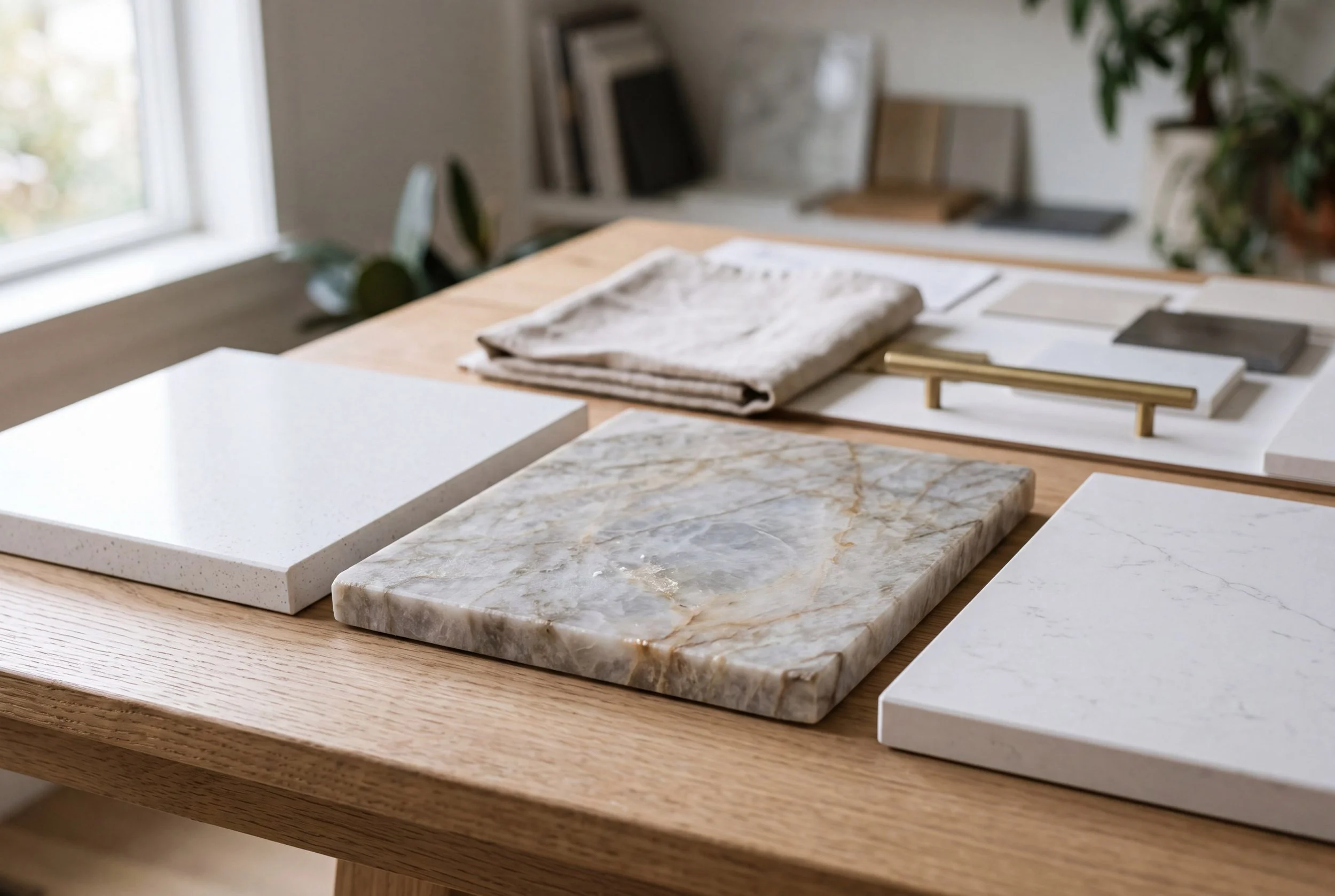
Concept image for illustration only.
What’s the Difference Between Quartz, Quartzite and Porcelain?
They sound alike, but they're three different materials.
Quartz (engineered stone) is made in a factory. Caesarstone describes it as "up to ~90% natural quartz aggregates with pigments and polymer resins." The resin is what makes it non-porous, and it's also its weak spot.
Quartzite is a natural metamorphic stone "made almost entirely of the mineral quartz," according to the Natural Stone Institute. Every slab is different.
Porcelain slabs are made from a blend of clay, feldspar and quartz fired at very high temperatures. Sintered stone (brands like Dekton and Neolith) is a close cousin, made from minerals under extreme heat and pressure.
Which Countertop Holds Up Best in a Real Kitchen?
Each one wins on something different. Here's how they compare on the things that matter day to day.
Hot pans: quartz needs a trivet, because heat can damage the resin. Quartzite and porcelain are both very heat-resistant.
Stains: quartz and porcelain are non-porous and very stain-resistant. Quartzite depends on sealing.
Sealing: quartz and porcelain don't need it. Quartzite usually does, depending on its porosity.
Sunlight: quartz resin can yellow over time. Quartzite is unaffected. Porcelain is UV-resistant and suitable outdoors.
Chipping: quartz and quartzite are durable. Thin, mitred porcelain edges are more prone to chips.
Look: quartz has a consistent pattern. Quartzite has natural, one-of-a-kind veining. Porcelain's pattern is usually printed on the surface.
Sources: Caesarstone Canada care manual, Natural Stone Institute, Neolith, Fine Homebuilding.
The "soft quartzite" problem
This is the one I warn every client about. The Natural Stone Institute says plainly: "There is no such thing as soft quartzite though... A rock labeled as soft quartzite is most likely marble." Marble etches when lemon juice or vinegar sits on it. Real quartzite doesn't.
Before you commit to a quartzite slab, ask for a sample and test it. Real quartzite scratches glass easily, and a lemon or vinegar spot left for about 15 minutes should leave no etch mark.
Porcelain edges and thickness
Porcelain is often installed at 12 mm thick, with a mitred edge to make it look thicker. Fine Homebuilding notes those mitred edges "are relatively brittle" and can chip if you drop a pot on them. Because most patterns are printed on the surface, a chip or a cut edge can show the plain body underneath. A good fabricator matters more with porcelain than with any other material.
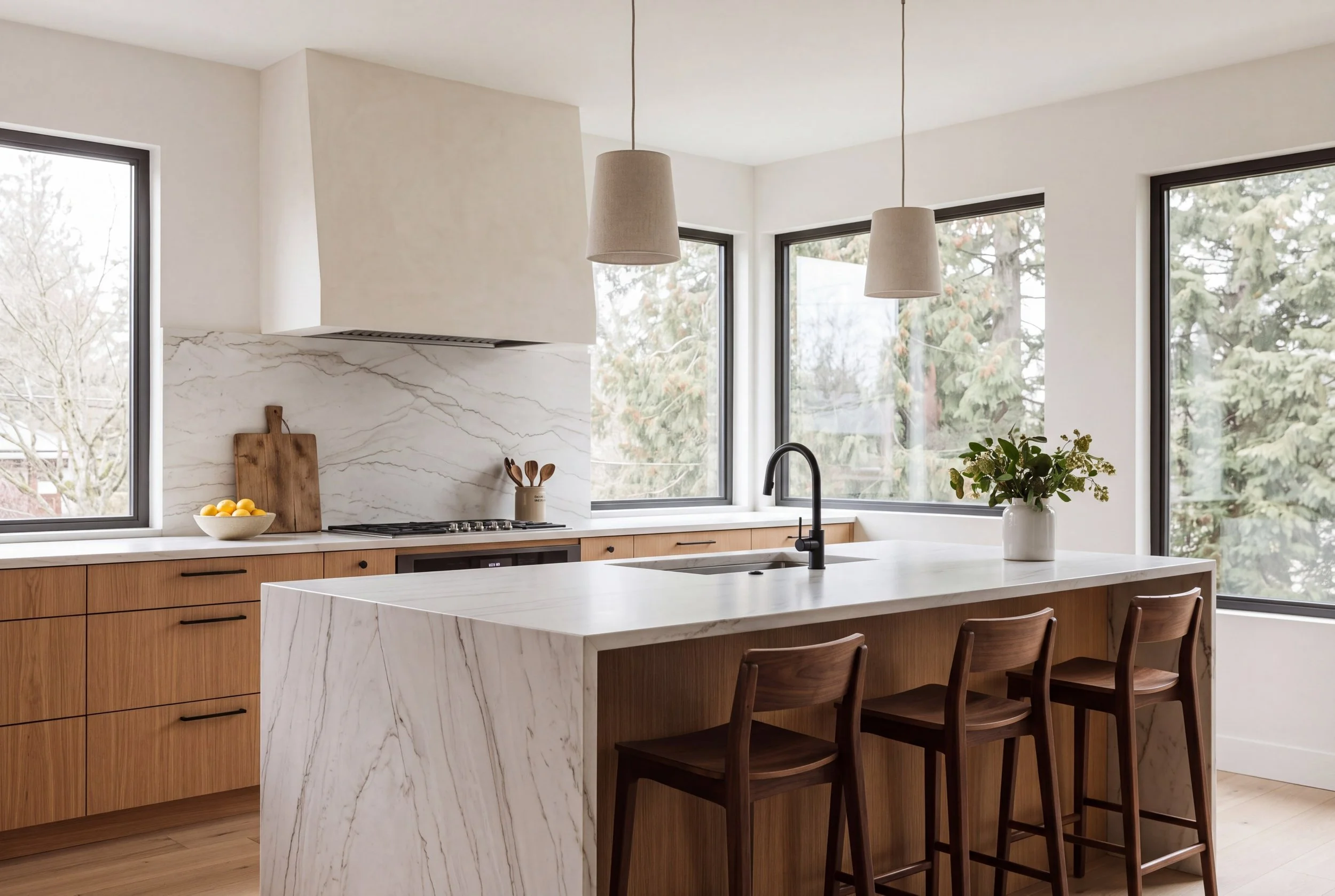
Concept image for illustration only.
How Much Do Quartz, Quartzite and Porcelain Countertops Cost in Vancouver?
Expect quartz to be the least expensive of the three, with quartzite and porcelain overlapping above it.
Here's what two Metro Vancouver fabricators published in 2026, installed, per square foot (Alpine Countertops, June 2026; Canadian Flooring & Renovations, July 2026):
Quartz: $70 to $120 (Alpine); $80 to $160 for 3 cm, and $130 to $220 for premium veining (Canadian Flooring & Renovations)
Quartzite: $110 to $180, with rare slabs over $200 (Alpine); $130 to $280 (Canadian Flooring & Renovations)
Porcelain / sintered: $90 to $140 (Alpine); $140 to $260 (Canadian Flooring & Renovations)
These are vendor estimates. Slab choice, edge detail, cut-outs, full-height backsplashes and waterfall ends all move the number.
What I Specify, and When
My honest take: choose the material for how you live, then choose the slab for how it looks.
Quartz
For busy family kitchens, condo kitchens and anyone who wants to wipe and walk away. I steer clear of it next to big south- or west-facing windows, and I always tell clients to use a trivet.
Quartzite
For a kitchen that should feel one-of-a-kind, like a character home or a West Coast modern kitchen where the stone is the art. You have to be fine with sealing and with natural variation. More on that style in West Coast Modern Kitchen Design in Vancouver.
Porcelain
For serious cooks who put hot pans down, for outdoor kitchens and covered patios, and for thin, modern profiles. I spend more time on edge details with porcelain, and I only use fabricators who work with it regularly.
A word on engineered stone and silica
Engineered quartz contains much more crystalline silica than natural stone. A WorkSafeBC article in the BC Medical Journal cites over 90% silica in engineered stone versus about 45% in granite and 5% in marble, and silica dust causes silicosis in the workers who cut it (BCMJ, 2026). Australia banned engineered stone benchtops from July 1, 2024. As of November 2026, I haven't found a ban in Canada or BC. Installed countertops aren't the hazard. Fabrication is. If it matters to you, ask your fabricator how they control dust, or choose a lower-silica material.
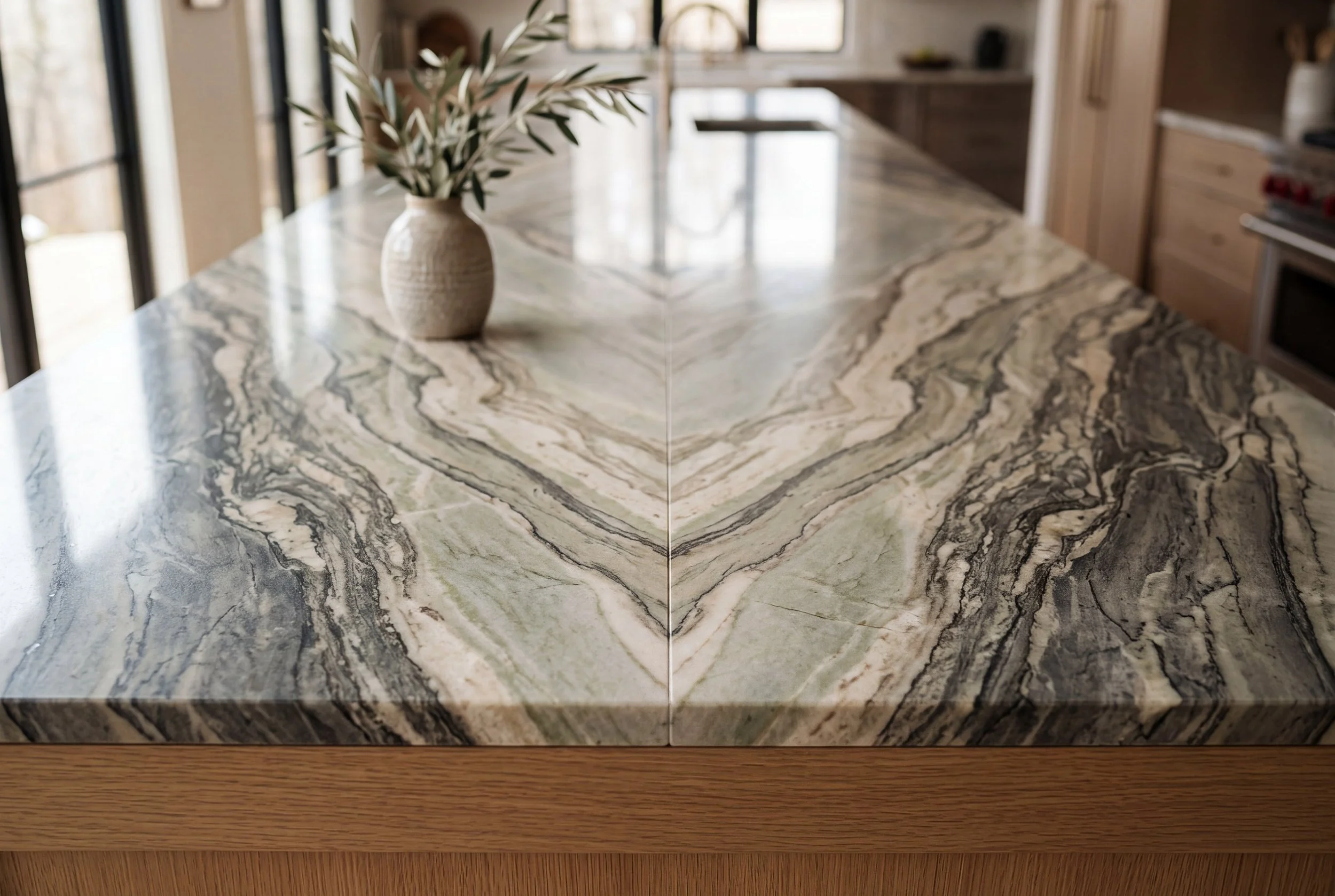
Concept image for illustration only.
How to Pick a Slab Without Regretting It
Most slab regrets come from deciding too fast. Work through these in order.
Lock your cabinet layout first. Seam locations and overhangs depend on it.
See full slabs, not samples. Go to a slab yard. In Metro Vancouver, suppliers like Margranite carry quartzite, engineered stone and porcelain.
Test natural stone. Do the glass-scratch and lemon tests on a sample before you put a deposit down.
Ask about seams and veining. Where will the seams go? Will the veining be matched across them?
Ask about edges. Especially for porcelain: what profile, how thick, and how will the corners be protected?
Tag your slab. For natural stone, reserve the actual slab you saw, not "something similar."
Countertops are one of the decisions I help with most often. If you're comparing options, you don't need a full design package. My e-design service can help you choose finishes remotely.
Countertop FAQ
Q: Is quartzite better than quartz?
Not better, different. Quartzite is natural stone with unique veining and excellent heat resistance, but it usually needs sealing. Quartz is engineered, more consistent and lower-maintenance, but heat can damage its resin. Choose quartzite for character and quartz for easy care.
Q: Is porcelain a good kitchen countertop?
Yes, if it's fabricated well. Porcelain handles heat and UV better than quartz and doesn't need sealing. The trade-offs are thinner edges that can chip and patterns that are usually printed on the surface, so edge details and an experienced fabricator matter.
Q: How can I tell if a quartzite slab is real?
Test a sample. Real quartzite scratches glass easily and won't etch when lemon juice or vinegar sits on it for about 15 minutes. Some stones sold as "soft quartzite" are actually marble, which etches.
Q: How much do quartz countertops cost in Vancouver?
Two Metro Vancouver fabricators published installed ranges of roughly $70 to $160 per square foot for standard quartz in 2026, with premium veined quartz higher. Edge details, cut-outs and backsplashes add to the total.
Q: Is engineered quartz banned in Canada?
Not as of November 2026, as far as I could find. Australia banned engineered stone from July 1, 2024 because of silicosis risk to fabrication workers. Installed countertops aren't the hazard. Cutting and grinding them is.
Choose the Material for Your Life, Then the Slab for Your Eye
A countertop is one of the biggest visual and budget decisions in a kitchen.
If you're planning a Vancouver kitchen renovation and want help getting it right, book a free discovery call. For the full picture, see my Vancouver kitchen renovation cost guide or recent HART HOUS kitchens.